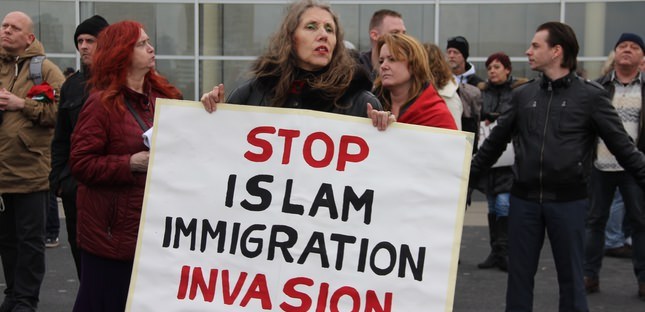
“Muslamic ray guns”

PART 1 

Defining Islamophobia

Islamophobia is so much more than just a simple ‘dislike of or prejudice against Islam or Muslims, especially as a political force’ (Oxford English Dictionary Online). It is an intense hatred for what encompasses the unknown. Islam is foreign. It is violent and it is threatening. Look at the rise of terrorist attacks in the contemporary. Muslim bearded men are radical and fanatical. Veiled Muslim women are medieval. We are submissive and passive. We are the epitome of oppression itself. We have yet to embrace our liberated white feminist sisters who have freed themselves of their patriarchal shackles.

The media

Gathering from the above statements, it is no wonder why Islamophobia is on the rise. Newspaper report after report after report of terrorist attacks, the rise of terrorism, the war on terror, Asian grooming gangs, ISIS, radicalised British teenagers, Hamas, the Syrian conflict, Muslim women’s illiteracy rate, Muslim women’s unemployment rate. Quite frankly, the media has a fetish for Muslims. They have an obsession with focusing on Muslims, and a compulsion with the ‘demonic rise of Islam’. It is manic. And this mania shapes and has shaped the way in which Muslims and Islam are perceived within the present.

Xenophobia unwrapped

Islamophobia however, is not merely just a hatred towards Muslims and Islam. No. It is xenophobia. It is racism wrapped around the fabric of religion. Simple as. Anyone who ‘looks’ Muslim, who ‘sounds’ Muslim, who has a ‘Muslim sounding name’ are the victims of islamophobic attacks: non-Muslim and Muslim blacks, Sikh’s, Hindu’s, Muslim, Christian and Jewish Arabs. Numerous physical attacks carried in the name of harming a Muslim, harming a terrorist have been perpetrated based on physical appearances and characteristics. The fact that individuals try to perpetrate who is Muslim and who isn’t based on physical appearance shows the profound level of ignorance prevalent in society towards minorities. Ultimately, these islamophobic attacks reveal society’s constructed ongoing racism and cyclical obliviousness to those who form the underclass. If people well and truly hated Muslims, and wanted to attack Muslims in the name of ‘protecting society from Islam’, then only Muslims would be the victims of these attacks. But they are not. Islamophobia is so much more than just people having negative stereotypes about Islam which are then manifested into attacks on Muslims. Islam is no longer just synonymous with the Middle East, Muslim men with violence and Muslim women with oppression. Islam has become synonymous with race and ethnicity and physical appearance.
 

1831

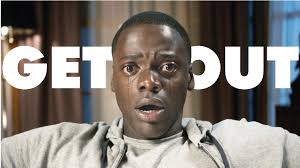
People love to act like Anti-blackness doesn’t exist in the Muslim community, but it does. I’ve seen it and heard it with my own eyes from people who I went secondary school with, people from university, and even my own family members sad to say. We all love to say racism doesn’t exist in Islam and recite a few passages from the Quran: An Arab is not better than a Non-Arab (…) or that Bilal R.A. one of our prophet’s dearest companion, a freed slave and the person who used to recite the call to prayer was black, but how many of us actually believe in that? When we are called out on our racism, we deny it and use Bilal R.A as the token Muslim black guy to justify our attitudes of racism, discrimination and prejudice, or we say that we ourselves are people of colour or a religious minority, therefore we cannot be racist nor discriminatory nor prejudice towards another group of people. That is bullshit.

Growing up, I’ve heard prejudice and discriminatory views projected towards Black people, both Black Muslims and Black non-Muslims, or even my own race by other Muslims, from people who I’ve called my friends. When it comes to Islamic events at universities or mosques, biryani amongst other South Asian dishes are always served. Where is the bariis, canjeero, jollof, jerk chicken, rice and peas at please?

Racism in the Muslim community is real. There is this whole idea reiterated that we can talk to Black people, perhaps be friends with them (God forbid our families see us walking down the road with a Black person), maybe even give them dawah and thus be the one to show them Islam, but then when you want to invite them to your house, or even marry one of them, then no, it’s not allowed.

These attitudes, feelings and ideologies of anti-Blackness have deep colonial and imperialist roots, which have passed down from generation to generation despite us living in a post-colonial era, supposedly. And when I speak of the colonial era, I am not speaking of explicitly the Britsh, Portuguese, Dutch, French and Italian empires, I am speaking of the Arab empire as well.

Stereotypes surrounding the Black womam as an ‘angry woman’ or the Black man as a ‘thug’ still exist in the contemporary. The media have a significant hand in constructing the Black identity, which in turn affects consumer’s and viewer’s perceptions surrounding blackness.

We ourselves need to question what we see and hear, and what we have seen and heard.

1980

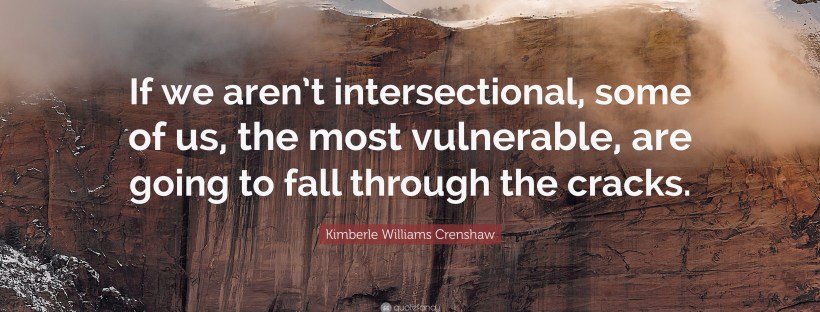
Intersectional feminism is a term coined by Kimberlé Williams Crenshaw: an American civil right advocate, as well as a professor specialising in racial theory. Though coined by Crenshaw, black feminists prior to Crenshaw such as Audre Lorde made intersectional feminist theory what it is prior to its founding as a study.

Intersectionality is the idea that different social, economic and political components come together to form an individual’s identity. These components include class, sex, gender, race, ethnicity, religion etc. Due to these different components, every man and every woman is perceived differently by society.

A middle class white woman’s experience, and how she is perceived in life, is different to that of a working class white woman’s, because of social, economic and financial factors which determine which class a woman fits the category of. A white woman’s experience is different to a black woman’s experience because a Black woman is seen in light of her Blackness.

Identity is very complex. There are so many different constituents that come together to determine why an individual is the way they are. Due to this, generalisation is an issue. To say that white feminism can be used to represent the struggle of black feminists is inaccurate. White feminists can use their voice to speak out against social injustices against themselves and other women, but they will never ever be able to relate to the oppression, discrimination, prejudice and struggle that black women go through on a day to day basis because they will never be discriminated against based on Blackness.

Similarly, to use the word Black culture to describe a Black individual or a whole race is very vague. There is a wide diaspora of Black people across the world who don’t share the same demographic location, each having their own cultural and ethnic customs and values distinct to them. In Ghana alone, there are around 250 languages spoken and over 100 different ethnic groups. Therefore, to generalise a person or group of people based on one shared intersection such as skin colour is both problematic and inaccurate.